

The NASA West Virginia Space Grant Consortium (WVSGC) invites all WV Middle and High School Teachers and Team Leaders from across the state to participate in the Plant the Moon or Build the Moon Challenge offered through the Institute of Competition Sciences. Interested teachers and youth leaders can apply for funding for either or both the Plant the Moon or Build the Moon Challenges by completing this application form. A detailed overview of these two challenges, task requirements for each challenge, and timelines are provided on pages 1 and 2 of this flyer.
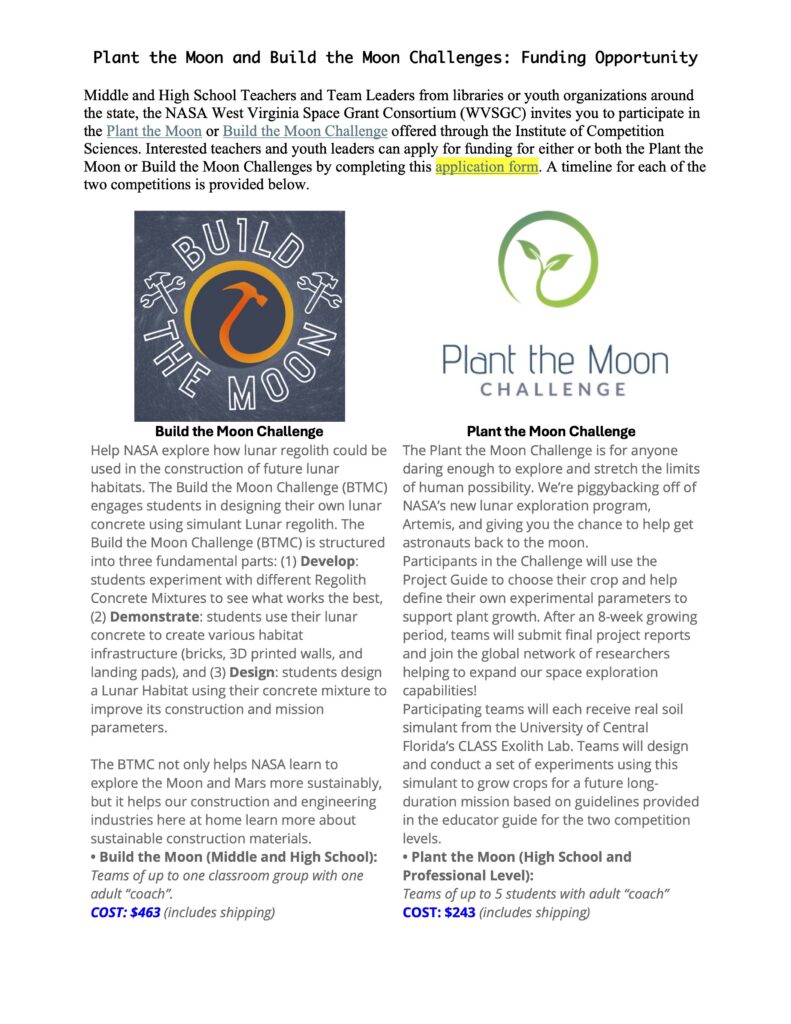
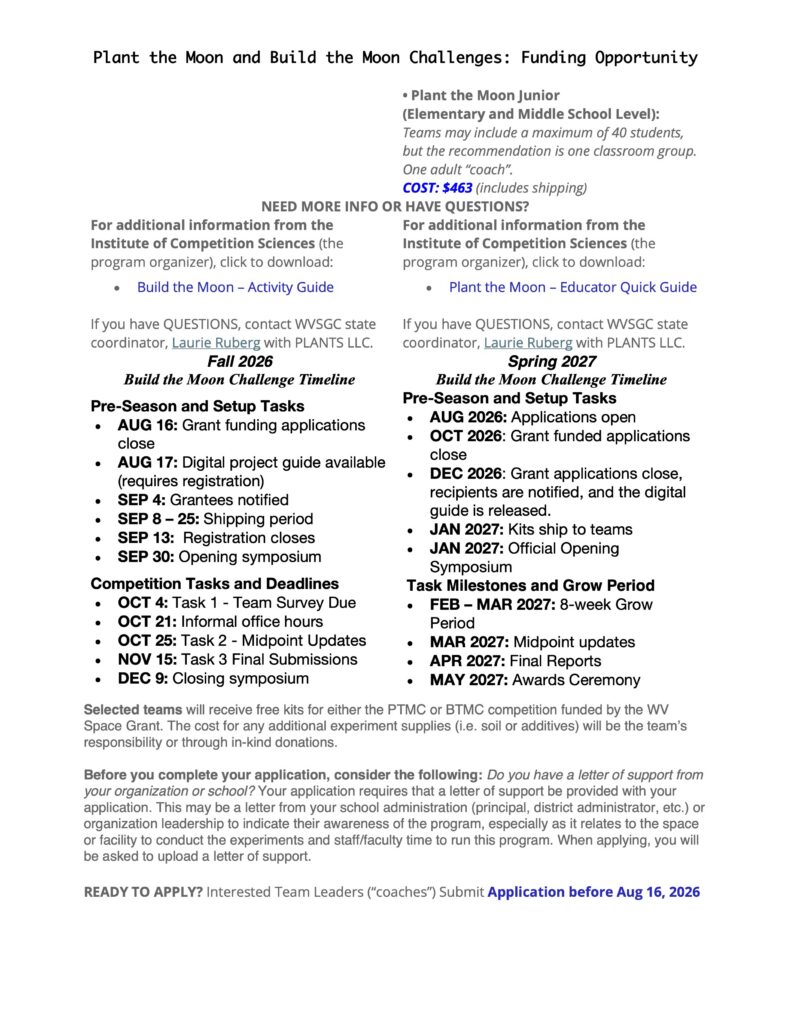
How do Plant the Moon and Build the Moon Challenges differ?
The Plant the Moon Challenge NASA Regional Expansion Project engages students in plant growth research that explores what crops and lunar regolith soil mixtures NASA scientists consider for future lunar habitats. In the Build the Moon Challenge, students help NASA explore how lunar regolith could be used in the construction of future lunar habitats. A detailed overview of these two challenges, their task requirements, and timeline is provided in this flyer.
What do participating educators receive if selected for a WVSGC award?
• Plant the Moon (High School and Professional Level):
Supports teams of up to 5 students with adult “coach”. (Each kit provides simulant packs with enough materials for around 5 plants/pots for the Regular Challenge.) The kit COST: $243 (includes shipping) is covered for this level awardees.
• Plant the Moon Junior (Elementary and Middle School Level):
Supports teams up to a maximum of 40 students, but the recommendation is one classroom group. One adult “coach”. (Each simulant pack provides for around 15 plants/pots for the Junior Challenge). The kit COST: $463 (includes shipping) is covered for this level awardees.
• Build the Moon (Middle and High School):
Supports teams of up to one classroom group with one adult “coach”. The kit COST: $463 (includes shipping) is covered for this level awardees.
*Awardees participating in both challenges at all levels will be included in opportunities to engage in STEM activities and virtual events that highlight NASA’s Artemis mission and space science research.
Eligibility: Team coaches can be middle or high school teachers or organizations such as Girl or Boy Scouts or 4-H clubs that work with this age group. The project has broad appeal to science, biology, botany, earth science, and agricultural and other related disciplines.
Timeline: The Build the Moon Challenge kits are mailed out in mid-September with Final Submission due November 15, 2026. The Plant the Moon Challenge kits are mailed out in early January with final reports due in mid-April of 2027.
Build the Moon Application Deadline: 15 August 2026
Plant the Moon Application Deadline: 1 October 2026
For more information contact L F Ruberg @gmail.com